.png?width=128&height=85&name=Logo%20(3).png)

In an industrial high-pressure washing environment, execution speed, operational mobility, and field autonomy have become fundamental pillars of profitability. Whether you operate in construction, road transport, agriculture, mining, or municipal services, keeping your heavy equipment clean and maintaining preventative care is a daily challenge. The accumulation of mud, grease, hydrocarbon deposits, de-icing salts, and chemical residues not only damages your brand image but also critically accelerates mechanical wear and increases the risk of breakdown.
Industrial high-pressure washing platforms—also known as wash tank skids—specifically designed to fit directly into the bed of a standard pick-up truck, deliver a perfectly adapted solution to these operational challenges. By converting a simple commercial vehicle into a mobile high-pressure cleaning station, these systems allow your crews to intervene anywhere, anytime, completely independent of local water networks and power grids.
Table of contents
- What is a High-Pressure Washer Platform?
- Mechanical Engineering & Configurations
- Key Components of an Industrial Skid
- Containment, Filtration & Wastewater Recovery
- Strategic Advantages & Return on Investment (ROI)
- Sector Applications & Field Use Cases
- Preventive Maintenance & Winterization
- Equipment Selection Criteria by Vehicle Type
- Maximize the Efficiency and Autonomy of Your Mobile Interventions
- Frequently Asked Questions (FAQ) about tank skid
What is a High-Pressure Washer Platform?
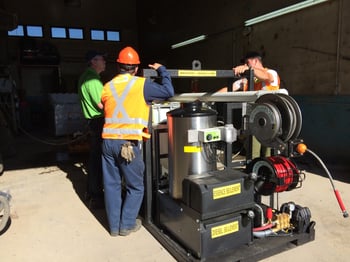
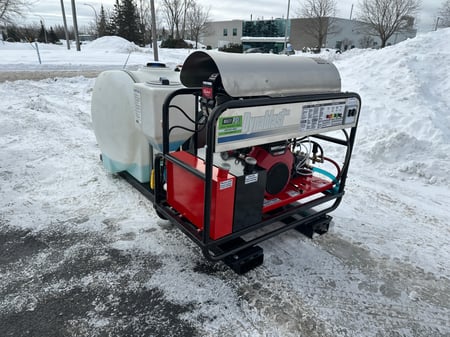
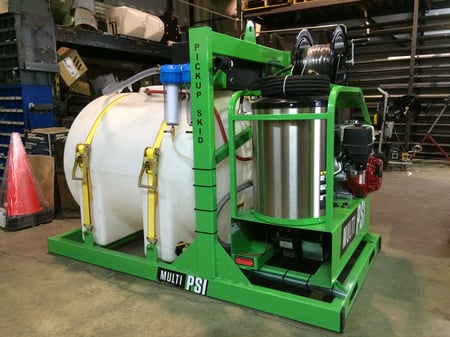
An industrial high-pressure washer platform, or tank skid, is a self-contained, highly structured cleaning unit built on a rigid tubular steel frame. This frame centralizes all core components required for commercial and industrial washing: the gasoline engine, industrial-grade high-pressure pump, water heating system (diesel burner), buffer water tank, hose reels, and washing accessories.
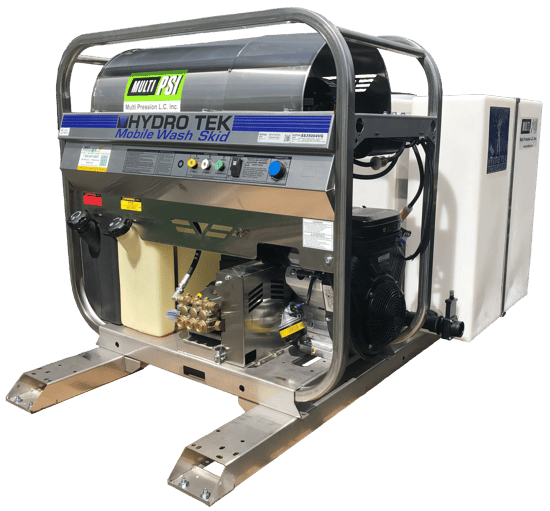
Unlike traditional pressure washing trailers—which introduce hitching constraints, lower permitted speed limits, complex maneuvering in tight jobsites, and additional maintenance requirements (brakes, trailer tires, signaling lights)—a skid fits directly and securely inside the bed of a standard pick-up truck (Short Bed or Long Bed).
This configuration preserves overall vehicle maneuverability, allowing easy access to dense urban environments or rough forest roads, while keeping the rear tow hitch free for hauling other jobsite equipment (such as air compressors, generators, or mini-excavators).
Conception mécanique et configurations
The efficiency of a pressure washer platform relies not just on raw engine power, but on the precise harmony of its mechanical components. Several technical choices must be evaluated based on the type of dirt to be treated and the intended usage intensity.
1. Cold Water vs. Hot Water (Diesel Burner)
-
Cold Water Units: Rely exclusively on high-pressure water impact force. Recommended for rinsing, removing dirt, sand, clay deposits, gravel, and non-greasy organic matter. They are lighter, highly compact, and require less maintenance.
-
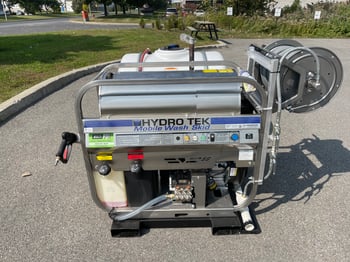
Hot Water Units: Feature an autonomous burner (powered by diesel or heating oil) and a heating coil enclosed in a stainless steel wrap. Hot water (reaching temperatures from 90°C to 120°C / 194°F to 248°F) alters grease viscosity. It breaks down the molecular bond between oil, grease, wax, bitumen, or bauxite and the cleaned surface. Using hot water reduces job time by up to 70% and drastically reduces chemical detergent consumption .
2. Direct Drive vs. Belt Drive
-
Direct Drive: The plunger pump is coupled directly to the engine crankshaft, running at full engine speed (approx. 3,400 to 3,600 RPM). It offers a compact footprint and lower upfront cost—ideal for intermittent or light commercial use (a few hours per week).
-
Belt Drive: Power is transmitted through a system of pulleys and notched belts, allowing the pump to rotate at a much lower speed (approx. 1,450 to 1,750 RPM). This speed reduction delivers key operational benefits:
Thermal Dissipation: Lower operating temperatures preserve pump seals and valves.
Vibration Absorption: Belts cushion mechanical shocks and pressure spikes from the spray gun.
Optimal Lubrication: Stable oil bath temperatures extend total pump life.
3. Axial Pumps vs. Ceramic Triplex Plunger Pumps
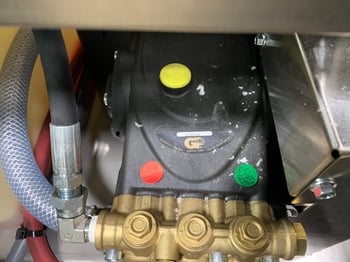
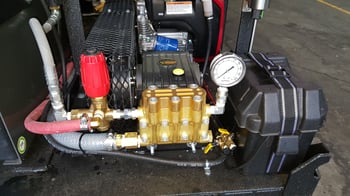
For professional and industrial applications, a triplex pump with solid ceramic plungers and a forged brass (or stainless steel) manifold is the gold standard. Smooth ceramic plungers do not scratch, resist thermal friction, and provide an airtight seal, unlike consumer axial pumps whose plastic or aluminum parts wear out quickly under high pressure. Furthermore, axial pumps are generally non-repairable, whereas triplex pumps are fully rebuildable.
Key Components of an Industrial Skid
An industrial high-pressure washer platform designed for intensive duty incorporates heavy-duty components engineered for maximum safety and operator ergonomics :
The Engine and Pump Assembly
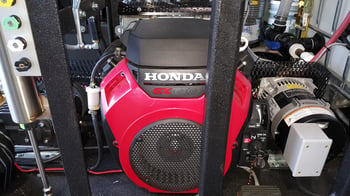
Industrial tank skids feature commercial-grade gasoline engines (such as Honda GX, Kohler, or Vanguard) or diesel engines (Kohler, Kubota) equipped with electric start, charging alternators, and low-oil shutdown sensors to prevent mechanical failure.
The Buffer Water Tank
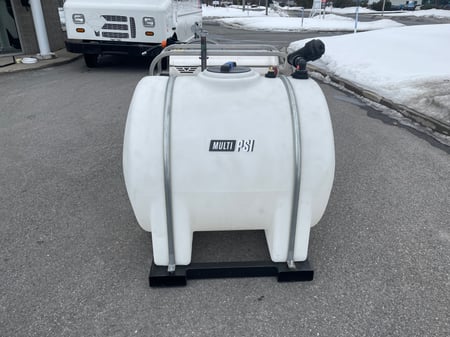
Manufactured from UV-resistant high-density polyethylene (HDPE), tank capacities typically range from 100 to 350 gallons (approx. 380 to 1,325 liters). Mandatory design elements include:
- Hold-Down Cage / Hoops: Structural steel frames secured over the tank to hold it firmly in place during transit.
- Anti-Surge Baffles: Internal partitions that break water waves created during acceleration, braking, and cornering, maintaining vehicle stability.
- Automatic Float Shut-off: Stops incoming water flow when connected to a city supply once full.
- Quick-Drain Dump Valve: Allows easy tank evacuation for maintenance or winterization.
Industrial Hose Reels
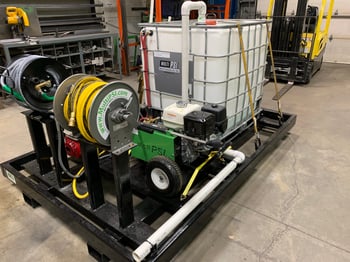
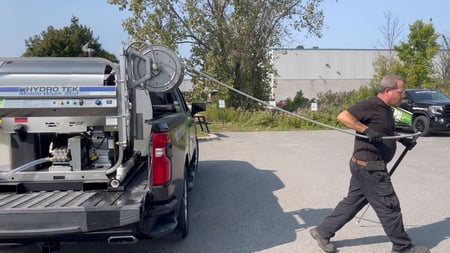
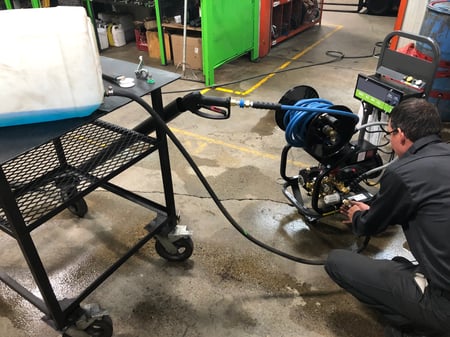
Proper hose management is essential on job sites. Heavy-gauge steel reels (such as Hannay Reels) allow effortless deployment and rewinding of up to 200 feet (60 meters) of 2-wire high-pressure hose, preventing kinking and extending hose lifespan.You can install several types of hose reels there: manual, spring-loaded, or electric.
Spray Accessories & Connections
- Ergonomic High-Pressure Spray Gun: Reduces operator muscle fatigue during extended shifts.
- Dual or Single Lances: Dual lances feature a bypass valve for instant switching between high-pressure washing and low-pressure soap application.
- Quick-Connect Nozzles: Full set of color-coded stainless steel nozzles (0° Red for pinpoint blasting, 15° Yellow for heavy stripping, 25° Green for general cleaning, 40° White for delicate rinsing, and Black for detergent).
- Rotary Turbo Nozzle: Combines the impact force of a 0° stream with the coverage of a 25° fan pattern, multiplying efficiency on concrete and rust.
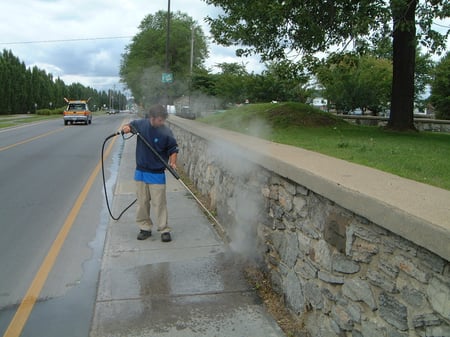
Containment, Filtration & Wastewater Recovery
Environmental regulations governing outdoor washing operations are increasingly strict. In most municipalities and eco-regulated jobsites, direct discharge of runoff containing oils, hydrocarbons, heavy metals, paint chips, and suspended solids into storm drains or soil is strictly prohibited and subject to heavy fines.
A modern high-pressure skid can be paired with a mobile containment and recovery system:
Containment Devices:
Inflatable or polyurethane containment berms placed around the wash zone to channel wastewater.
Heavy-duty PVC wash mats allow vehicles or equipment to park directly on top.
Vacuum & Separation Systems:
Surface scuppers and vacuum berms connected to high-draw industrial vacuum units or skid-mounted transfer pumps continuously capture standing water from the pad.
Wastewater passes through oil-coalescing separators, sediment cartridge filters (down to 5 microns), and activated carbon media.
Closed-Loop Recycling:
Purified water can be recycled back into the skid's buffer tank for pre-wash cycles, saving thousands of gallons of water in remote locations.
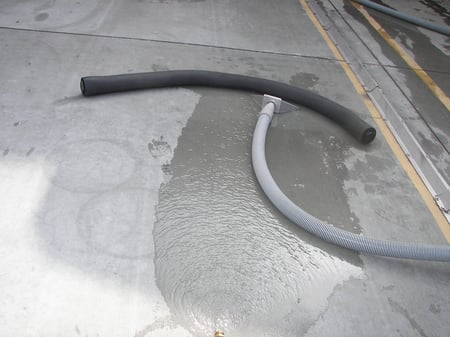
Strategic Advantages & Return on Investment (ROI)
Investing in an industrial high-pressure washer skid is not an expense—it is a strategic capital investment that provides clear, measurable returns.
Productivity Gain & Labor Reduction
Thanks to an appropriate GPM flow rate and hot water power, the time required to clean a construction truck or excavator drops from 2 hours (with residential or semi-pro equipment) to less than 30 minutes. Labor costs assigned to maintenance are significantly reduced while lowering operator fatigue and injury risks.
Reduced Machinery Downtime
A machine covered in mud or grease hides early hydraulic leaks, frame cracks, and belt wear. Regular jobsite cleaning facilitates daily mechanical inspections, catching failures before they cause major breakdowns on site.
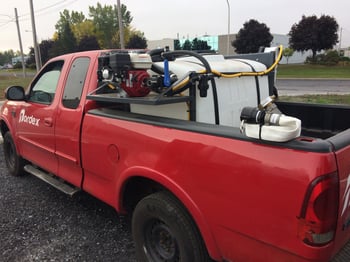
Savings on Licensing & Registration
Unlike managing a fleet of trailers (which require separate registration, annual road safety inspections, and regular tire/bearing replacements), the skid integrates into your existing vehicle. No heavy additional insurance premiums or special driver's licenses are required.
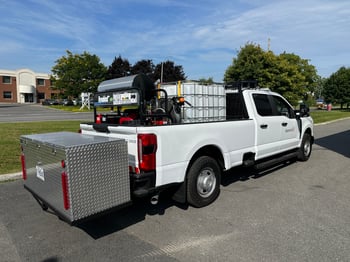
Service Versatility & Value Addition
For a contractor or service provider, owning a self-contained mobile unit opens up new high-margin service offerings: municipal graffiti removal, commercial loading dock degreasing, pre-paint surface prep, agricultural facility sanitation, and winter culvert/sewer thawing.
Sector Applications & Field Use Cases
Truck-bed mounted pressure washer platforms adapt to demanding applications across diverse industries:
- Construction & Excavation: Cleaning tracks, chassis, and buckets of excavators, loaders, and haul trucks directly on site.
- Commercial Transport & Logistics: On-demand fleet washing without driving trucks to distant wash bays.
- Mining & Aggregates: Removing heavy clay, slurry, and ore buildup from haulers and crushing plants.
- Municipal & Infrastructure: De-icing catch basins, sidewalk cleaning, graffiti removal, and public asset washing.
- Agricultural Use Case: Biosecurity and disease prevention are critical. Skids allow instant mobile hot-water decontamination and disinfectant application at farm entry gates to protect crops and livestock against viral or bacterial transmission.
Preventive Maintenance & Winterization
Preventive Maintenance Schedule
1. Daily Inspections (Before each use)
- Check engine oil level; top off if necessary.
- Check triplex pump oil sight glass (oil level must sit in the center of the glass).
- Inspect inlet water filter screen; clean out debris.
- Inspect high-pressure hoses for outer jacket cuts, bulges, or exposed wire braid.
- Verify fuel levels (gasoline for engine and diesel for burner).
- Perform the first pump oil break-in change at 50 hours (then every 300 hours or annually using non-detergent ISO68 high-pressure pump oil).
- Clean or replace engine air filter.
- Inspect drive belt tension and pulley alignment on Belt Drive models.
- Inspect burner ignition electrode and fuel nozzle.
Rigorous Winterization Procedure (Freeze Protection)
Steps for Safe Winterization:
- Drain the buffer tank completely by opening the main bottom drain valve.
- Disconnect the tank suction line and submerge it into a bucket containing non-toxic RV/Marine plumbing antifreeze (rated to -50°C).
- Start the engine at low RPM with the spray gun open (no high-pressure nozzle attached).
- Squeeze gun trigger until pure pink (or original color) antifreeze flows steadily from the lance tip.
- Release the trigger briefly to allow antifreeze to circulate through the bypass line and unloader valve.
- Shut off the engine immediately. The system is now fully freeze-protected.
Equipment Selection Criteria by Vehicle Type
Before installing a skid, you must verify your truck's payload capacity to ensure road safety, avoid overweight fines, and protect suspension and braking systems.
Payload Calculation Formula
"Total Loaded Weight"="Dry skid weight"+("Tank volume in gal." ×8,34" lb" )+"Fuel, hoses and accessories"
Sample Calculation:
Full 200-gallon water tank (200 × 8.34): 1,668 lbs
Fuel (gas + diesel) & accessories: 150 lbs
Total Payload Weight: 2,568 lbs (~1,165 kg)
Recommendations by Truck Class
- 1/2-Ton Trucks (e.g., Ford F-150, RAM 1500, Chevy Silverado 1500): Limited to ultra-compact cold water skids with a maximum 100-gallon buffer tank, or tankless skids fed directly by jobsite water supply.
- 3/4-Ton Trucks (e.g., Ford F-250, RAM 2500, Chevy Silverado 2500): Well suited for hot or cold water skids with 150 to 200-gallon maximum tank capacity.
- 1-Ton+ Trucks (e.g., Ford F-350/F-450, RAM 3500/4500 SRW/DRW): Recommended for heavy-duty industrial hot-water units equipped with 250 to 300-gallon tanks and dual hose reels.
Maximize Mobile Intervention Autonomy
Integrating an industrial high-pressure washer skid into your pick-up bed represents a major step forward in optimizing field operations. By choosing a robust design—featuring a commercial engine-pump package, durable industrial reels, a baffled water tank, and a high-efficiency heating system—you equip your business with a dependable, autonomous, and highly profitable mobile asset.
Frequently Asked Questions About Tank Skid Platforms (FAQ)
What is the fundamental difference between PSI and GPM for an industrial platform?
PSI (Pounds per Square Inch) measures water impact force that breaks dirt adhesion. GPM (Gallons Per Minute) measures water flow rate that rinses and flushes away debris. In industrial settings, high GPM (e.g., 5 to 8 GPM) is often far more important than extreme PSI because it drastically speeds up rinsing time.
Can a high-pressure platform be operated without a buffer water tank?
Yes, provided the pump connects directly to a pressurized water source delivering flow equal to or greater than pump requirements. However, a buffer tank is strongly recommended to prevent pump cavitation caused by water supply fluctuations.
What type of fuel powers a mobile hot water unit?
Typically, the engine runs on unleaded gasoline (or diesel on specialized industrial units), while the burner operates on diesel/heating oil. Some high-end custom units draw diesel from a single shared tank.
Why choose Hannay Reels for a pressure washer skid?
Hannay Reels are heavy-duty industrial reels coated with powder-paint finish to resist water and chemical corrosion. Their powder-coated steel construction reduces the risk of corrosion caused by water and detergents. Their high-pressure rotating seals withstand continuous rotational movement without leaking, and their reinforced structure absorbs the repeated jolts the vehicle experiences when traveling on bumpy roads or unpaved construction sites. Furthermore, the components of genuine Hannay reels are replaceable, unlike those of other brands on the market.
How do I choose between Direct Drive and Belt Drive systems?
For heavy commercial use (over 15–20 hours/week) or multi-operator crews, Belt Drive is mandatory. It runs the pump at half speed (1,450–1,750 RPM), reducing heat and thermal stress. Direct Drive is suitable for light or occasional use.
Is it safe to drive with a partially filled water tank in a truck bed?
Driving with a partial tank is hazardous due to liquid sloshing ("free surface effect"). Skids must feature internal baffles to control liquid movement. For highway speeds, driving with a fully empty or fully full tank is recommended.
What is the average lifespan of an industrial pressure washer skid?
With routine maintenance (oil changes, filter checks, winterization), an industrial skid powered by a commercial engine and ceramic triplex pump lasts 2,000 to 4,000 operating hours (approx. 8 to 12 years of regular commercial service).
Can harsh chemicals or acids be drawn directly through the pump?
No. Aggressive chemicals (aluminum brighteners, acids, strong degreasers) will destroy pump seals and valves. Detergents must be applied downstream using a low-pressure chemical injector or foam cannon after the pump.
How should operating pressure be adjusted properly?
Pressure should be adjusted by changing the nozzle orifice size at the lance tip—not by over-tightening the unloader valve. Overtightening forces the pump and engine into constant high-pressure bypass, causing premature mechanical failure.
What environmental regulations apply to outdoor pressure washing?
Regulations prohibit wash water containing oil, heavy metals, or chemicals from entering storm sewers or waterways. Operators must use containment berms, storm drain plugs, and vacuum recovery/filtration units, or haul sludge via certified waste handlers.
Author : Multi PSI has been an expert in pressure washing equipment for over 25 years. As an equipment distributor, we also offer mobile and in-shop repair services. We are recognized for our expertise in custom projects, including washing platforms and trailers, as well as the installation of washing systems with reels, poles, rails, and compressed air network systems.
Updated on July 30, 2026