.png?width=128&height=85&name=Logo%20(3).png)
Regular cleaning of heavy vehicles poses a major daily challenge for municipalities and transport companies across Quebec. The accumulation of mud, road grit, and de-icing salts accelerates the deterioration of bodywork, chassis, and mechanical components. Without proper infrastructure, managing fleet maintenance quickly becomes a costly operation in terms of time, water, and labor.
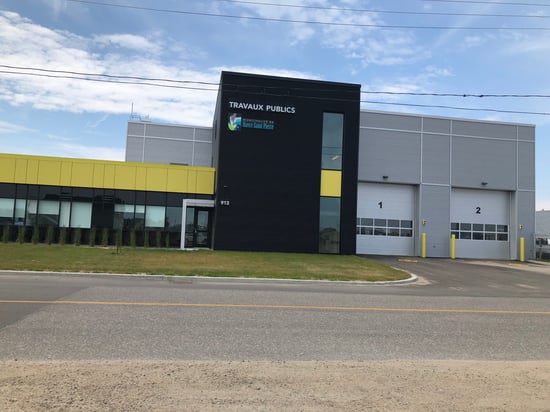
To address this concrete issue, the Municipality of Havre-Saint-Pierre called upon Multi PSI’s expertise to design and install a fully customized truck fleet wash bay. The main objective of this project was to deliver a heavy-duty, ergonomic hot water pressure washing station capable of maintaining a demanding workload while optimizing energy consumption and detergent usage.
Table of contents
- Essential Requirements for Effective Heavy Vehicle Cleaning
- The MPC4030-HE4-63 High-Pressure Unit and Its 48 kW Water Heater
- Facility Layout: The Dedicated Mechanical Room
- Workplace Ergonomics: The Rail System and Dual-Line Management
- Selection of MPSI-5011 Biodegradable Industrial Detergent
- Municipal Wash Bay Summary Table
- Maintenance Tips to Preserve High-Pressure System Performance
- Optimize Your Fleet Maintenance Starting Today
- Frequently Asked Questions About Industrial Wash Bays
Essential Requirements for Effective Heavy Vehicle Cleaning
Managing a fleet of municipal or commercial trucks requires a strict level of cleanliness for operational and safety reasons. Snowplows, waste collection trucks, and heavy machinery are constantly exposed to harsh contaminants. Built-up grime can hide premature wear or mechanical leaks that require quick visual inspection during routine maintenance.
Basic surface cleaning with a standard garden hose is not enough to loosen baked-on grease and embedded dirt underneath vehicles. It requires adequate hydraulic pressure combined with high water temperature to dissolve fatty substances effectively. Furthermore, the massive size of trucks demands equipment that allows operators to move effortlessly around the vehicle without unnecessary physical strain.
An effective truck fleet wash bay must combine four essential factors: pressure, water flow, heat, and chemical action. By balancing these elements, fleet managers reduce vehicle downtime in the wash bay and extend the service life of their rolling equipment.
The MPC4030-HE4-63 High-Pressure Unit and Its 48 kW Water Heater
At the heart of the wash bay designed for Havre-Saint-Pierre is the stationary motor-pump unit model MPC4030-HE4-63. This high-pressure equipment was selected for its reliability and capability to withstand intensive industrial use. Powered by a 575-volt electrical network, this system offers optimal operational stability for commercial and municipal facilities.
This unit generates a working pressure of 3,000 PSI with a water flow rate of 4 gallons per minute (GPM). The combination of 3,000 PSI and 4 GPM rapidly dislodges stubborn grime without risking damage to industrial paint or electrical wiring on heavy vehicles. It strikes the right balance between impact force and effective rinsing.
To maximize water cleaning power, the installation incorporates a 48 kW electric water heater. The consistent heat provided by this heater dissolves oils and road film much faster than a cold-water system. This significantly reduces manual brush usage and allows operators to complete each wash cycle in record time.
Facility Layout: The Dedicated Mechanical Room
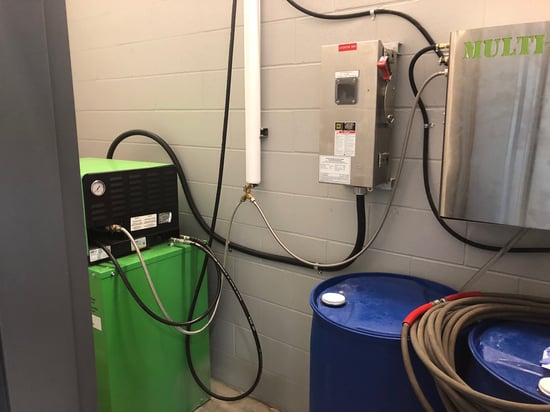
To ensure the durability of the high-pressure equipment, all primary machinery was installed in a separate mechanical room adjacent to the wash bay. This structural choice protects the motor-pump, electrical panels, and water heater from extreme humidity, water splashes, and direct detergent overspray.
Isolating the equipment in a technical room also provides a major advantage regarding noise reduction in the working area. Operators work in a quieter environment, improving daily comfort and reducing fatigue during long truck cleaning shifts.
This setup also facilitates preventive maintenance operations. Service technicians can access pump oil, filters, and electrical connections without interfering with employees working inside the main wash bay.
Workplace Ergonomics: The Rail System and Dual-Line Management
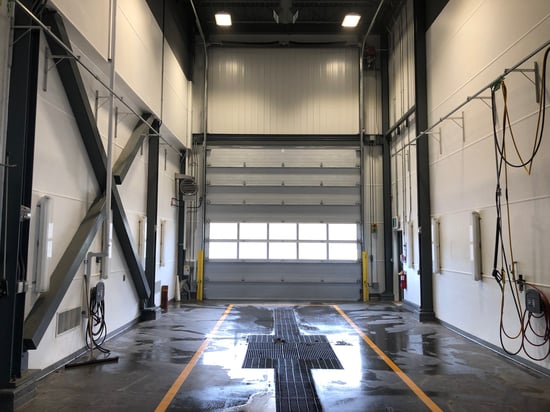
One of the greatest challenges when washing heavy vehicles is handling high-pressure hoses. Hoses dragging on the ground suffer premature wear under truck tires, present tripping hazards for workers, and slow down movement around large vehicles.
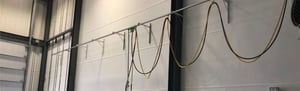
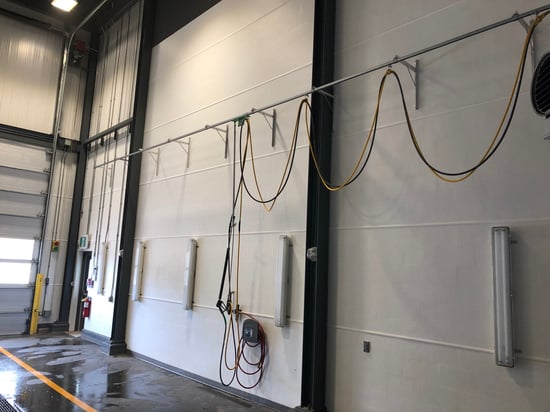
To eliminate this problem, the Havre-Saint-Pierre installation features a wall-mounted rail system in the wash bay. This sliding system allows operators to move hoses effortlessly along both sides of the room. Workers can walk entirely around the truck without dragging heavy hoses across the floor.
The system features two distinct lines connected to the rail:
- A dedicated line for hot high-pressure water used for rinsing and blasting away dirt.
- A dedicated line for detergent application featuring an integrated soap mixer for precise chemical dosing.
This dual-line configuration eliminates the need to purge the main hose between soap application and high-pressure rinsing. The operator switches functions instantly, eliminating wasted time and chemical runoff.
Selection of MPSI-5011 Biodegradable Industrial Detergent
The overall efficiency of a wash bay depends on the quality of the cleaning chemicals used. For this municipal facility, MPSI-5011 biodegradable industrial detergent was selected. This high-grade soap is formulated to strip away road film, brake dust, and greasy residue from heavy vehicle bodies.
The MPSI-5011 detergent is stored in a dedicated drum inside the mechanical room and feeds directly into the rail system’s mixer. Automatic dosing guarantees a consistent chemical mixture, preventing over-application that wastes money and harms the environment.
By choosing a highly biodegradable detergent, the Municipality of Havre-Saint-Pierre reaffirms its commitment to environmental protection and compliance with provincial regulations in Quebec. This selection protects operator health while ensuring a clean, streak-free finish on fleet vehicles.
Municipal Wash Bay Summary Table
The following table outlines the major components installed for this industrial project and their practical benefits for fleet management.
|
System Component |
Technical Specification |
Key Operational Benefit |
| High-Pressure Washer |
Model MPC4030-HE4-63 (3000 PSI, 4 GPM, 575V) |
Consistent power for quick removal of heavy dirt |
| Heating System | 48 kW Electric Water Heater | Accelerated dissolution of grease and road film |
| Technical Room | Isolated Dedicated Mechanical Room | Equipment protection against corrosion and noise reduction |
| Hose Management | Sliding Dual-Line Rail System | Superior ergonomics, zero floor hoses, and easy truck perimeter access |
| Degreasing Agent | MPSI-5011 Biodegradable Industrial Detergent | Eco-friendly cleaning with no harsh residue on paint |
Maintenance Tips to Preserve High-Pressure System Performance
An investment in a truck fleet wash bay must be protected by a regular preventive maintenance program. Even heavy-duty industrial equipment requires methodical upkeep to avoid unexpected breakdowns during harsh winter months.
Here are our technical team's recommendations for maintaining peak system performance:
- Pump Oil Check: Monitor the high-pressure pump oil level every 300 hours of operation and perform oil changes according to manufacturer guidelines.
- Nozzle and Lance Inspection: Regularly inspect wash nozzles. Worn nozzles increase water volume while dropping system pressure, reducing mechanical cleaning action.
- Soap Line Maintenance: Periodically flush chemical injection lines with clean water to prevent dried soap buildup inside the injector.
- Suspended Rail Servicing: Check trolley rollers on the ceiling/wall rail and check hose tension to maintain smooth movement.
Following these simple steps ensures component longevity and prevents unplanned downtime.
Optimize Your Fleet Maintenance Starting Today
The facility built for the Municipality of Havre-Saint-Pierre proves that a well-designed truck fleet wash bay combines performance, worker safety, and environmental care. By isolating machinery in a mechanical room, using a dual-line rail system, and heating water with a powerful 48 kW heater, this installation guarantees quick, efficient cleaning for all municipal vehicles.
At Multi PSI, we design, install, and service custom high-pressure washing systems tailored to the operational realities of local businesses and municipalities. Whether you need to modernize an existing wash bay or build a complete setup for your fleet, our team supports your project from start to finish.
Contact our specialists today to discuss your requirements and request a personalized evaluation of your facility.
Frequently Asked Questions About Industrial Wash Bays
What water pressure is ideal for washing a truck fleet?
A pressure between 2,500 PSI and 3,000 PSI with a water flow rate of at least 4 GPM is ideal for heavy vehicles. This combination removes mud and road grime without damaging paint.
Why should machinery be installed in a separate mechanical room?
Placing the high-pressure washer and water heater in a mechanical room protects machinery from steam, moisture, and chemical corrosion. It also significantly reduces noise inside the operator work area.
How does a rail system improve workplace safety?
A rail system keeps high-pressure hoses suspended off the floor. This eliminates trip hazards for workers and prevents hoses from being crushed by truck tires.
What are the benefits of hot water compared to cold water for heavy vehicle washing?
Hot water dissolves oil, grease, soot, and road salt much faster than cold water. It reduces total cleaning time by nearly 50% and requires less detergent consumption.
Is MPSI-5011 detergent safe for vehicle finishes and the environment?
Yes, MPSI-5011 is a biodegradable industrial formula engineered to remove road film without damaging paint, glass, or aluminum surfaces, all while meeting environmental standards.
What electrical service is required for an industrial wash bay?
Heavy-duty high-pressure systems like the MPC4030-HE4-63 and its 48 kW water heater typically require a 575-volt, 60-amp 3-phase electrical connection, which is standard in commercial and municipal buildings in Quebec.
Can a second wash station be added to a single system?
Yes, depending on total water flow and main pump capacity, distribution piping can be configured for multiple drops. However, we strongly recommend dedicated high-pressure units for each wash bay per active user.
How long does it take to install a complete wash bay?
Timeline depends on building infrastructure, but installing high-pressure units, water heaters, and overhead rails typically takes 1 to 2 days with our qualified installation crew.
Why use separate lines for high-pressure water and soap?
A dual-line configuration allows operators to apply detergent at low pressure and immediately switch to high-pressure rinse water without waiting for chemical residue to flush out of a single line.
What types of trucks can be washed in this bay?
This custom system handles all heavy vehicle types: waste collection trucks, snowplows, fire trucks, commercial transport trucks, trailers, and heavy construction machinery.
Author: Multi PSI has been an expert in high-pressure washing equipment for over 25 years. As an equipment distributor, we also offer mobile and workshop repair services. We are recognized for our expertise in custom projects, including washing platforms and trailers, as well as the installation of washing systems with reels, poles, or rails.
Updated on August 5, 2026