.png?width=128&height=85&name=Logo%20(3).png)
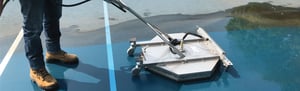
Cleaning large surfaces such as sidewalks, patios, driveways, parking lots, or garage floors can quickly become a time-consuming and exhausting task. When performed using only a standard high-pressure lance, this work often leads to significant wasted time and uneven results marked by sweep lines. To optimize the yield of your operations and achieve a uniform finish, the rotary surface cleaner stands out as the essential piece of equipment.
Faced with the diversity of models available on the market, selecting the ideal tool requires a rigorous analysis of your current equipment. Whether dealing with conventional models, water recovery systems, or hand-held units for vertical surfaces, each option meets a specific need. This comprehensive guide details the fundamental technical criteria for choosing a high-performing, durable surface cleaner perfectly adapted to your pressure washer.
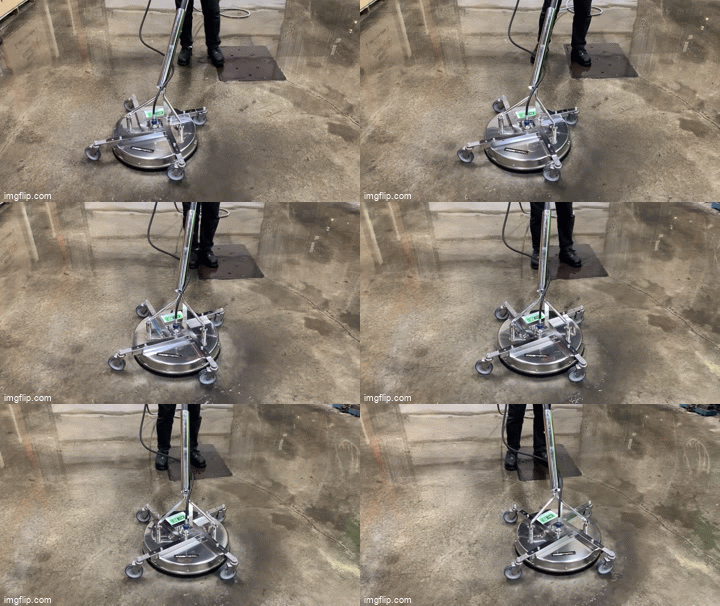
Table of contents
-
The Fundamental Equation: Flow Rate (GPM), Pressure (PSI), and Diameter
-
Specialized Technologies: Water Recovery, Venturi Effect, and Graffiti
Understanding How a Surface Cleaner Works
A rotary surface cleaner operates using a housing under which spins a spray bar equipped with high-pressure nozzles. Driven by the hydraulic force of water, this bar rotates at high speed while maintaining a constant distance from the area being treated. This design covers a consistent working width in a single pass, eliminating the variations in distance inherent to cleaning with a manual lance.
Key technical advantages
Using a rotary housing offers three major benefits for contractors and maintenance crews:
- Execution Speed: Coverage per pass is up to four times faster than with a standard pencil or fan nozzle.
- Visual Uniformity: The complete elimination of zebra-striping marks guarantees a professional finish on concrete and asphalt.
- Operator Protection: The safety dome contains splashes of water, sand, and debris, improving job site safety.
Fields of application and specialized uses
Surface cleaners are not limited to simple residential slab washing. Their technical features meet the hygiene, safety, and environmental demands of numerous sectors.
Splash pads and municipal parks
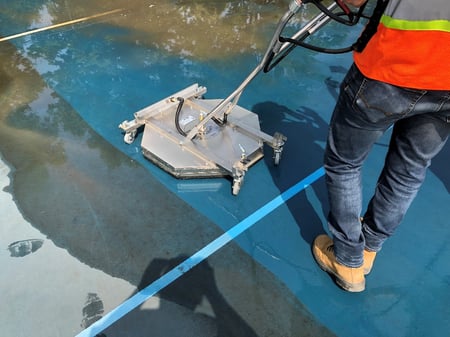
Splash pad surfaces, as well as tennis and pickleball courts, accumulate residues such as biofilm, algae, chemical deposits, and environmental dirt that make the ground extremely slippery and deteriorate the grip needed by players. Using a surface cleaner applies a perfectly even and controlled mechanical impact without tearing up or damaging soft coatings, acrylic paint, or specialized anti-slip treatments on these sports surfaces. Furthermore, for water parks and splash pads, models equipped with a water recovery system prevent contaminated water and debris from flowing back into recirculation drains.
Parking lots, driveways, and large concrete slabs
In commercial parking areas, the accumulation of dust, efflorescence, and grime tarnishes the property's image. A 21- to 30-inch surface cleaner allows you to clean thousands of square feet per hour with minimal labor.
Gas stations
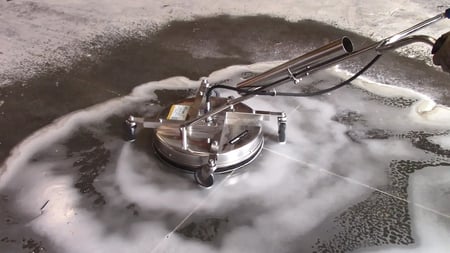
Access lanes around fuel pumps accumulate deposits of hydrocarbons, diesel, and heavy grease. The combined use of a stainless steel surface cleaner with hot water dissolves oils without splashing hazardous products onto surrounding facilities or vehicles.
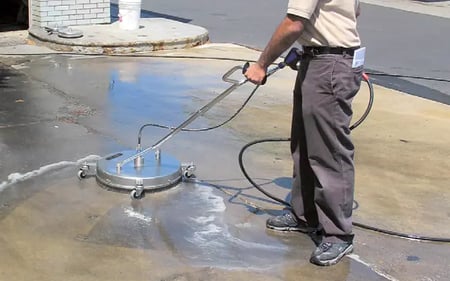
Commercial kitchens and food processing plants
In processing plants and commercial kitchens, hygiene is strictly regulated. Floors must be degreased without wastewater seeping under fixed equipment. 12-inch models equipped with a Vacuum Recovery system clean and dry the surface almost instantly.
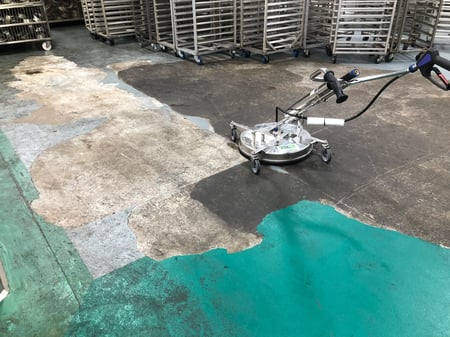
Mechanic garages and maintenance shops
Service bays accumulate motor oils, brake fluid, and tire residue. The uniform rotary impact dislodges contaminants embedded in the concrete's pores, restoring the floor to its original appearance while preventing the dispersion of silica dust.
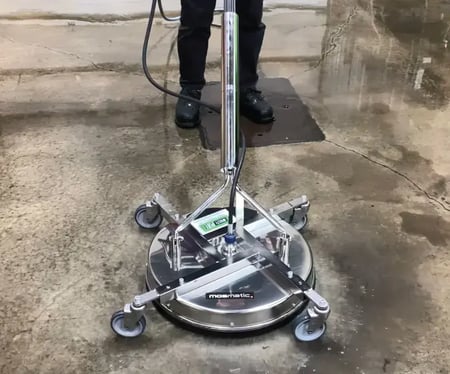
Patios, decks, and paver stones
For landscape hardscaping, the challenge is to dislodge moss, lichen, and stains without destroying the polymeric sand joints between pavers. A surface cleaner set to the right pressure provides even stripping without washing out the joints.
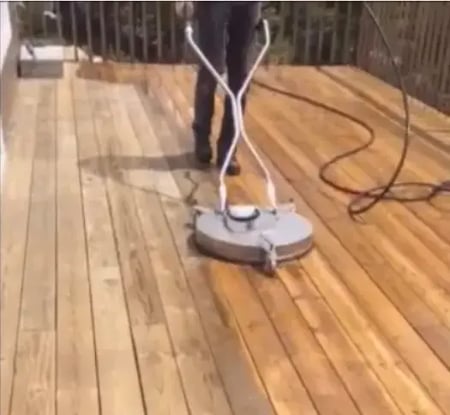
The fundamental equation: Flow rate (GPM), Pressure (PSI) and Diameter
The most common mistake when selecting a surface cleaner is choosing the widest possible dome without considering the pump's capacity. If the flow rate in gallons per minute (GPM) is insufficient to feed the dome's diameter, the rotation speed drops and overall efficiency decreases.
The importance of water flow rate (GPM)
Flow rate is the determining factor for the unit's travel speed. A pump delivering a high GPM powers wider domes while maintaining the impact force necessary to strip away dirt.
Worjing pressure (PSI)
Pressure determines the mechanical stripping force applied to the surface. A pressure of 3000 to 4000 PSI is generally recommended for commercial concrete, whereas lower pressures must be used on more fragile surfaces like wood or paver stones.
The Mosmatic line and premium component durability
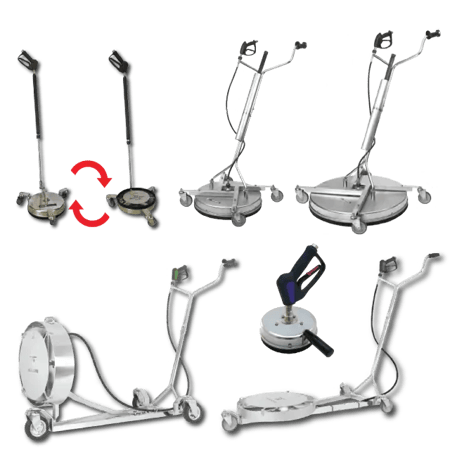
In the industrial high-pressure cleaning field, the Swiss brand Mosmatic represents the ultimate benchmark for manufacturing quality, precision, and longevity.
The swivel head: The mechanical heart
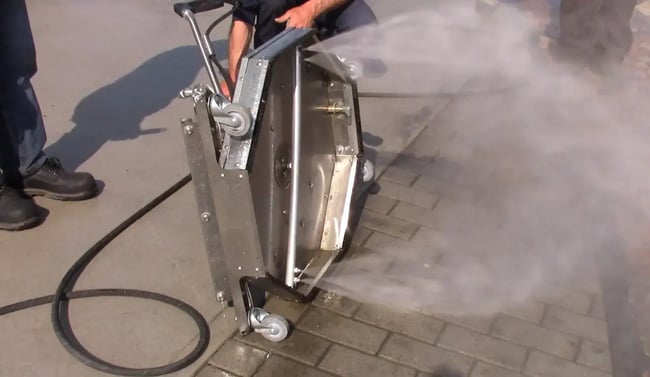
The swivel head is the most heavily stressed part of a surface cleaner. Mosmatic's top-tier models incorporate reinforced swivels featuring self-lubricating ceramic ball bearings and high-precision seals. These components withstand high temperatures and extreme rotation speeds, guaranteeing a lifespan far superior to standard parts.
Housing materials and internal geometry
Mosmatic stainless steel skid plates offer exceptional resistance to stone chips and corrosion. The internal geometry of the dome is specially designed to reduce air resistance and channel water flow, thereby optimizing mechanical impact on the ground. You can explore our complete selection in the underbody and surface cleaner category.
Popular sizes : 12, 16, 21 and 30 inches
Choosing the dome size must match both the power of your pressure washer and the layout of the areas to be cleaned.
The 12-inch format
The 12-inch dome is particularly suited for confined spaces, stairs, and areas requiring high maneuverability. It is also the preferred diameter for integrated vacuum recovery and Venturi systems, where concentrated suction power is critical.
The 16-inch format
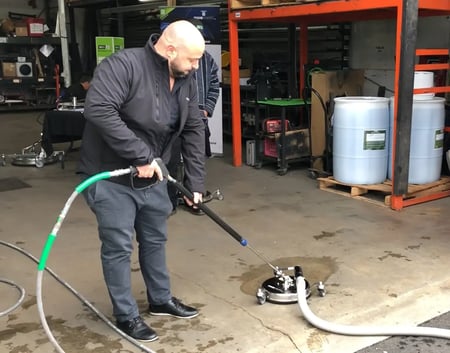
The 16-inch cleaner is an ideal choice for pumps delivering between 3 and 4.5 GPM. Highly maneuverable, it is perfectly suited for cleaning curbs, sidewalks, and residential driveways.
The 21-inch format
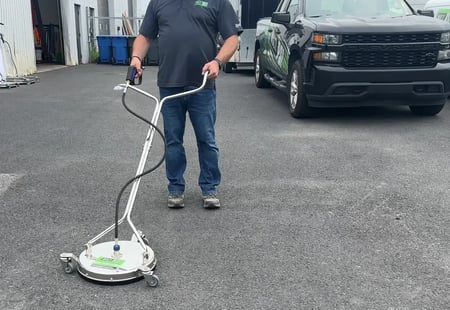
The 21-inch model is the primary workhorse for cleaning contractors. Used with a 4 to 6 GPM pressure washer, it offers the perfect balance between coverage speed and maneuverability.
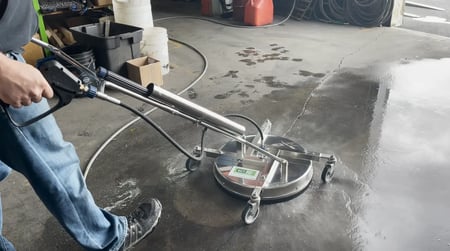
The 30-inch format
Designed for large spaces such as parking lots and industrial slabs, the 30-inch dome allows you to cover massive surface areas in record time, reducing the labor required on site.
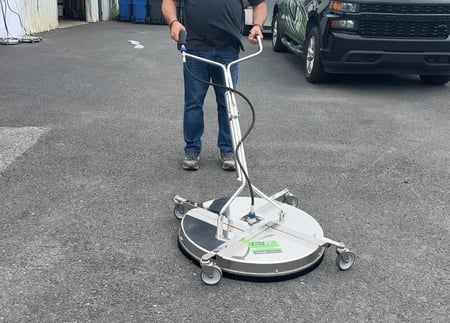
Pressure drops and high-pressure nozzle sizing
The actual performance of a surface cleaner directly depends on the correct calibration of the nozzles installed on the spray bar. An improper nozzle size can cause significant pressure loss or overload the pump.
The impact of hose length
When water flows through a high-pressure hose, internal friction creates a drop in pressure known as pressure loss. For example, with a 3500 PSI machine using a 3/8-inch hose, the loss is roughly 300 PSI per 100 feet. Over a 300-foot length, pressure at the surface cleaner drops to 2500 PSI.
To compensate for this loss over long distances, it is recommended to use a 1/2-inch diameter hose or adjust the nozzle orifice size.
Specialized Technologies: Water Recovery, Venturi Effect, and Graffiti
Depending on environmental requirements and the nature of the job, certain advanced features prove essential.
Vacuum recovery systems and Ventury effect
In urban areas or indoor settings, discharging wastewater into storm drains is strictly regulated. Surface cleaners equipped with a water recovery system vacuum up dirty liquid instantly during washing.
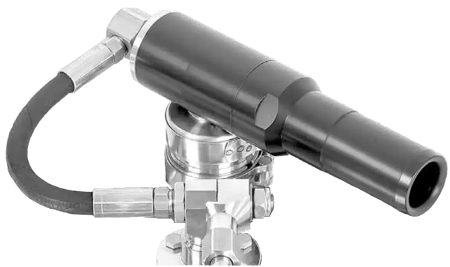
12-inch models utilizing the Venturi effect harness water velocity to create a vacuum, eliminating puddles on the work area without requiring an external vacuum motor.
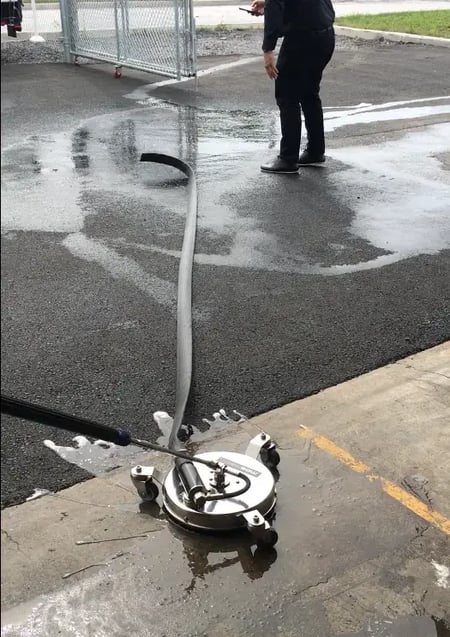
Vertical cleaning and graffiti removal
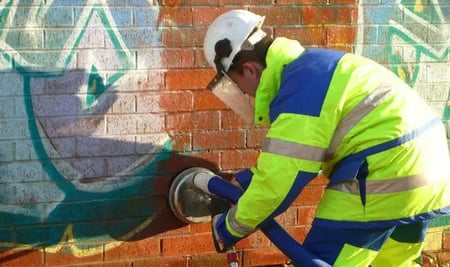
For work on walls, masonry, or vertical structures, using a standard ground dome is impossible. In this case, we recommend using an 8-inch hand-held surface cleaner.
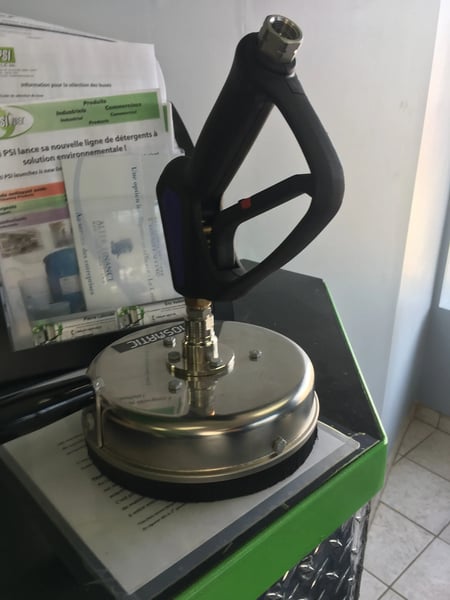
Equipped with ergonomic handles and a lightweight housing, this 8-inch tool allows for constant pressure against vertical surfaces to swiftly remove graffiti, peeling paint, and grime from facades, all while protecting the operator from overspray.
Comparative table of configurations based on your needs
The following table summarizes the recommended combinations of pumping equipment, dome size, and application type:
| Dome size | Recommended flow rate (GPM) | Optimal pressure (PSI) | Primary application |
| 8 inch (Hand) | 3.0 to 4.0 GPM | 2000 to 3000 PSI |
Graffiti, walls, facades, and vertical surfaces |
| 12 inch | 3.0 to 4.5 GPM | 2500 to 3200 PSI |
Kitchens, confined spaces, wastewater recovery |
| 16 inch | 3.5 to 5.0 GPM | 2500 to 4000 PSI |
Sidewalks, curbs, residential projects |
| 21 inch | 3.5 to 5.0 GPM | 3000 to 4000 PSI |
Commercial entrances, concrete slabs, splash pads |
| 30 inch | 4.0 to 8.0 GPM | 3000 to 4000 PSI |
Large surface areas, parking lots |
Maximizing the profitability of your cleaning jobs
Choosing the right surface cleaner relies on a precise match between your pressure washer's flow rate, the housing diameter, and nozzle size. By investing in durable equipment like the Mosmatic line or specialized 12, 16, 21, or 30-inch models, you reduce labor time on every job site while improving finish quality. Regular swivel head maintenance and frequent nozzle inspections will ensure maximum profitability year after year.
Frequently asked questions (FAQ)
What surface cleaner diameter should I choose for my pressure washer?
The general rule of thumb is to allow roughly 4 to 5 inches of dome diameter per GPM available from your pump. For a 3 GPM pressure washer, a 16- to 21-inch surface cleaner is ideal.
Why is it better to choose Mosmatic surface cleaner?
Mosmatic cleaners feature premium stainless steel construction, rebuildable ceramic bearing swivel heads, and Swiss engineering that ensures exceptional durability.
What is the advantage of a 12-inch surface cleaner with a Ventury system?
The 12-inch format concentrates flow power to activate the Venturi effect, ensuring efficient wastewater suction without requiring a heavy external vacuum unit.
How do I clean graffiti off a vertical wall with a surface cleaner?
For walls and facades, use an 8-inch hand-held surface cleaner equipped with specialized handles that allow you to hold the tool safely against the surface. It can be paired with graffiti cleaning chemical products.
Why is my surface cleaner leaving swirl lines or circles on the ground?
This occurs if the unit is being moved too quickly relative to the available GPM, or if a nozzle on the rotating arm is partially clogged by debris.
What is the difference between a 21-inch and a 30-inch model?
The 21-inch model is maneuverable and suited for 3 to 6 GPM pumps. The 30-inch dome requires an industrial pump and covers large parking lots twice as fast.
Can I use hot water with a rotary surface cleaner?
Yes, most professional models and the Mosmatic range accept hot water up to 180°F or 250°F (80°C to 120°C), making it easier to dissolve grease and oils.
Can surface cleaners be used on all surfaces?
Surface cleaners are designed for hard surfaces such as concrete, asphalt, pavers, and certain stone slabs. Use on fragile or unstable surfaces is not recommended.
Can I use a surface cleaner on paver stones without damazing the joints?
Yes, by adjusting the working pressure and maintaining a proper spray angle, you can clean the paver surfaces without dislodging the polymeric sand in the joints.
What is the maximum hose lengh I can use without losing performance?
Beyond 100 feet of 3/8-inch hose, pressure drop becomes significant. To maintain pressure at the tool over distances of 200 to 300 feet, it is best to switch to a 1/2-inch diameter hose.
Author: Multi PSI has been an expert in high-pressure washing equipment for over 25 years. As an equipment distributor, we also offer mobile and workshop repair services. We are recognized for our expertise in custom projects, including washing platforms and trailers, as well as the installation of washing systems with reels, poles, or rails.
Updated on July 23, 2026