.png?width=128&height=85&name=Logo%20(3).png)
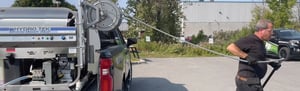
Starting your own exterior cleaning business is an exciting venture, but your initial equipment choice can make all the difference between a thriving company and endless job sites. On the field, your high-pressure washer is the heart of your operations: it determines not only the quality of your work, but also the speed of your interventions and the satisfaction of your first clients. Making the right choice from the start is essential to maximize your profitability and build a solid reputation.
With so many models available on the market, it is easy to get lost between power, water flow rate, and technical components. For intensive commercial use, gas-powered pressure washers are the go-to standard thanks to their complete autonomy and raw performance, far beyond the limits of residential units. In this article, we break down the fundamental criteria to help you select the ideal gas pressure washer, perfectly adapted to the demands of your future contracts.
Table of contents
- What you need to know about high-pressure washers
- Residential, commercial, or industrial pressure washers: what are the differences?
- Hot water or cold water: which option to choose?
- Direct drive or belt drive?
- Questions to ask yourself before getting started
- Our top 3 high-pressure washers to start a business
- Choosing a high-pressure washer is a matter of needs
- FAQ: Still have questions about high-pressure washers?
What you need to know about high-pressure washers
What is a high-pressure washer?
A pressure washer is a piece of equipment consisting of an engine driving a pump, which propels water at high pressure through a closed circuit. High pressure generally ranges between 500 PSI and 5000 PSI. Beyond this range, the equipment is considered very high pressure or ultra-high pressure.
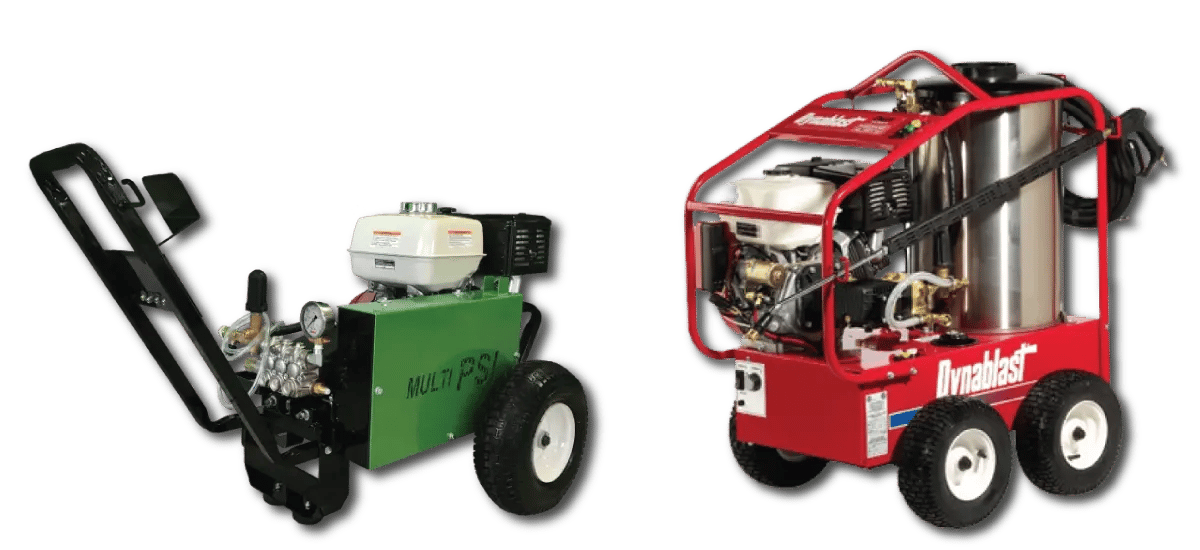
What is the difference between PSI and GPM ?
PSI (pounds per square inch) represents the pressure at which the water is ejected, while GPM (gallons per minute) corresponds to the flow rate—that is, the volume of water used. Although it varies depending on the application, generally speaking, the dirtier the surface, the more important the GPM becomes. For example, a 2000 PSI machine at 4 GPM will be far more effective than a 4000 PSI model at 2 GPM.
Residential, commercial, or industrial pressure washers: what are the differences?
-
Residential pressure washers often emphasize high PSI (e.g., 3500 PSI at 2 GPM) but neglect the flow rate (GPM). Industrial models prioritize high GPM for optimal efficiency and feature more heavy-duty pumps. In terms of cost, residential washers are less expensive upfront, but their lifespan is shorter. Industrial washers cost more initially, but their durability and ease of repair ensure a long-term investment.
-
A commercial or industrial pressure washer is designed to be repairable, built with durable components that can be individually replaced or serviced. Conversely, residential models—often manufactured with plastic or low-quality parts—are disposable once defective.
-
Industrial pressure washer feature external components (unloader valves, pressure gauges, water outlets) that are easily replaceable, unlike residential pumps where these elements are often integrated directly into the pump body and cannot be repaired.
Hot water or cold water: which option to choose?
Using hot water offers superior cleaning power, especially for greasy or deeply embedded grime on trucks, heavy equipment, or heavily soiled exterior siding. That said, for cleaning pavers, fences, masonry surfaces, or for landscaping projects, a cold water pressure washer is often more than sufficient.
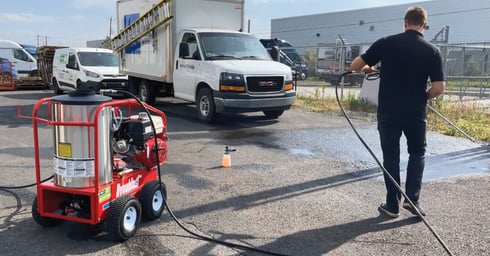
Direct drive or belt drive: which to choose?
A direct drive pressure washer connects the engine directly to the pump. This type of equipment is suitable for daily use in short bursts (around 1 hour per day).
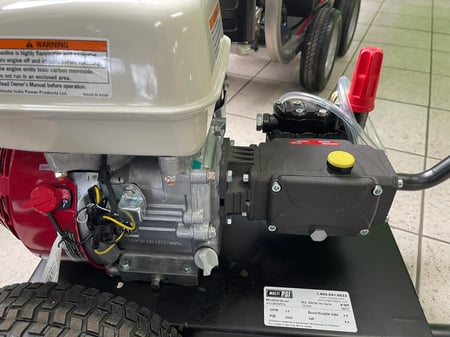
A belt drive pressure washer uses a pulley and belt system to turn the pump. Because there is no direct thermal or mechanical stress transfer between the engine and the pump, this system runs cooler and is ideal for intensive, multi-hour daily use over consecutive days. It is also significantly more durable.
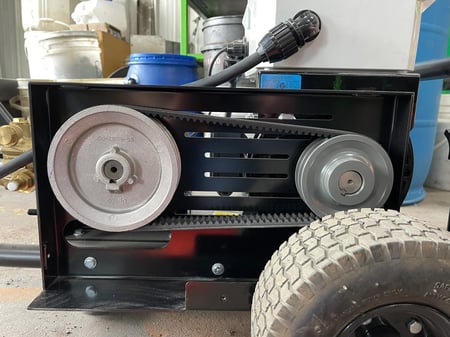
👉 For more details, read our article: Belt Drive vs. Direct Drive.
Questions to Ask Yourself Before Getting Started
What will my target market be?
The choice of your commercial or industrial pressure washer depends directly on your target market. Are your clients residential, commercial, industrial, or a combination of all three? This will influence not only the cleaning equipment required, but also your transportation setup, required power output, and the scope of services offered.
What will my water supply source be?
Water supply is a frequently overlooked factor when choosing a washing setup. In residential settings, a standard connection to the municipal supply is usually sufficient. However, for work on industrial, agricultural, or rural sites, a self-contained system with an onboard water tank offers much greater flexibility. This solution allows you to operate even when water access is limited, while reducing setup times and maximizing team productivity on the road.
How will I transport my washing equipment?
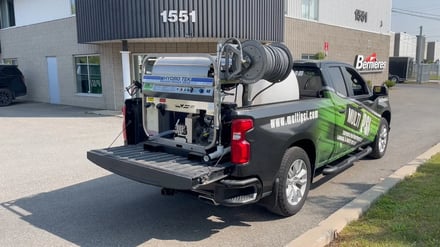
Parking space is rarely an issue in rural areas or suburbs, making open or enclosed trailers an easy choice. In urban centers, traffic and parking present major challenges. In those environments, opting for a compact wash skid mounted inside a cargo van (such as a Transit or Econoline) may be the better route.
What will my service offering be?
The type of service you provide determines how frequently and how long you run your pressure washer. If you handle short but frequent cleaning tasks (e.g., kitchen exhaust hoods, dumpster pads, vehicle detailing), a direct drive model may suffice. For industrial, heavy machinery, or fleet washing lasting several consecutive hours, you will need a robust belt drive model.
Furthermore, if your work involves grease removal (such as restaurant exhaust hoods), hot water becomes mandatory. Conversely, for landscaping or paver restoration work, a solid cold water system paired with a rotary nozzle gets the job done.
What is my starting budget?
Your initial budget will strongly dictate your choices. Key expenses to account for include:
- The equipment itself: Cold water models are less expensive than hot water units, so match your selection to your target market.
- The vehicle: Expenses vary significantly depending on whether you choose an open trailer, enclosed trailer, or a vehicle-mounted skid.
- Accessories: Tanks, hose reels, hoses, spray guns, nozzles, and surface cleaners must be budgeted.
- Assembly and maintenance: You can build your configuration yourself to save money, but a professionally installed system delivers greater reliability. Routine maintenance can be handled in-house, but you must reserve funds for unexpected repairs.
👉 Good news: You can launch your business with a few thousand dollars and upgrade your setup as your needs and client base grow.
Our Top 3 Pressure Washers to Start a Business
Option 1: MPJ4035BG – Cold Water Machine
General Description
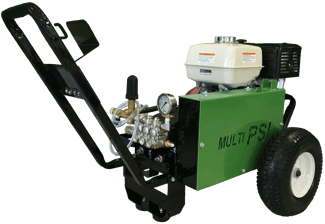
The MPJ4035BG pressure washer is perfect for launching a business if your applications do not require hot water. It delivers 3500 PSI at 4 GPM, making it ideal for residential and light commercial washing. Thanks to its compatibility with rotary nozzles, it excels at cleaning pavers and hardscapes. The pressure can also be dialed down (to 1000 PSI) for soft-wash applications like house or vehicle washing.
Advantages
- 3500 PSI at 4 GPM provides versatility across various job types.
- Honda GX630 engine paired with an industrial Italian pump.
- Assembled in Canada with fully replaceable components.
- Belt drive system engineered for extended daily use.
- Easily transportable by two people.
Disadvantages
- Operates on cold water only.
- Manual pull start (electric start available at an additional cost).
Budget
Expect $3,500 to $5,000, including basic accessories.
Option 2: H4035DGF – Hot Water Machine
General Description
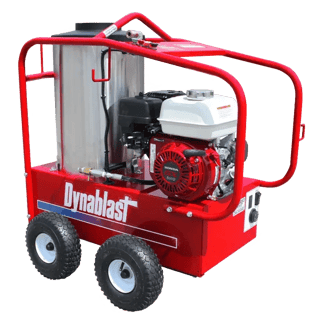
The H4035DGF pressure washer is an ideal choice if you need a hot water machine for a few hours of operation per day. Outputting 3500 PSI at 4 GPM, it is versatile enough for washing trucks, heavy machinery, buildings, or trash bins. It features a diesel burner capable of heating water up to 180°F.
Advantages
- Hot water with a diesel burner: ideal for grease and oil removal.
- Reliable Honda GX630 engine.
- 12-volt electric starter.
- Industrial Italian pump.
- Heavy-duty design with protected thermostat and powder-coated steel frame.
Disadvantages
- Direct drive unit: not recommended for non-stop, high-intensity daily use.
- Top-mounted pump setup limits gravity-fed water intake options.
Budget
Expect $8,000 to $10,000, including essential accessories.
Option 3: Wash Skid or Trailer Unit
General Description
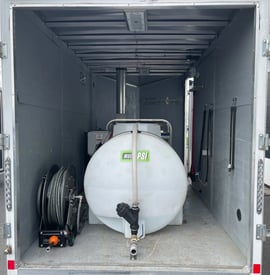
The ultimate solution for full-time cleaning professionals is a self-contained wash skid or a fully outfitted trailer unit. These systems integrate an industrial hot water pressure washer, water tank, and hose reels into a single package built to handle demanding commercial workloads.

Advantages
- Fully customized to your specific market and operational needs.
- Complete jobsite autonomy thanks to the integrated water tank.
- Built for heavy-duty daily operations (4 to 12 hours per day).
- Expandable with foamers, chemical injectors, extra reels, and more.
Disadvantages
- Requires technical self-reliance: multiple components to maintain.
- Multi PSI can assist you with system design and maintenance.
Budget
Expect $15,000 to $30,000 depending on equipment, layout, and level of customization.
Choosing a Pressure Washer Is a Matter of Needs
Starting a pressure washing business requires reliable equipment tailored to your operational needs and target market. Whether you select a cold water machine, a hot water unit, or a complete trailer-mounted skid, the key is thinking long-term. Invest in durability, serviceability, and versatility to secure your long-term success.
FAQ: Still have questions about high-pressure washers?
What is the difference between a residential and an industrial pressure washer?
An industrial pressure washer is built to be serviced, last for years, and withstand daily heavy-duty use. Residential models are generally disposable once a major component breaks.
Do I need a hot water model to start out?
Not necessarily. If your work focuses on greasy surfaces or industrial equipment, yes. However, for standard residential cleaning, cold water is usually sufficient.
Can I transport a pressure washer in a standard van or pickup truck?
Yes, especially if you use a compact skid unit. This is an excellent, maneuverable setup for urban environments.
Is a belt drive pressure washer essential?
If you plan to run the machine continuously for several hours a day, yes. For short, intermittent uses, a direct drive unit can get the job done.
What is the difference between pressure washing and soft washing?
Pressure washing uses high mechanical water force (high PSI) to strip dirt from hard surfaces like concrete and brick. Soft washing uses low pressure (around 1000 PSI or less) combined with specialized cleaning solutions to safely clean delicate surfaces like vinyl siding, stucco, or roofs without causing damage.
What type of fuel and oil should I use for my equipment?
For gas engines, use quality unleaded gasoline (preferably ethanol-free to protect the carburetor). For the high-pressure pump, exclusively use non-detergent pump oil (typically ISO68 grade) to prevent internal foaming, thermal breakdown, and premature wear.
How do I prevent pump damage when the spray gun is released?
When you release the trigger, the machine enters bypass mode, recirculating water within the pump head. Leaving a machine in bypass for more than 2 to 3 minutes causes friction heat that can destroy the pump seals. You should turn off the engine during breaks or install a thermal relief valve to purge hot water automatically.
Is a buffer water tank necessary on my rig?
It is highly recommended if your machine’s flow rate (GPM) exceeds what a standard outdoor spigot can output (often capped at 4 to 5 GPM). An onboard buffer tank (50 to 100 gallons) ensures a steady water supply, preventing pump cavitation and air locks.
What essential accessories should I buy right from the start?
Beyond the machine itself, budget for a sturdy hose reel with 100 to 150 feet of high-pressure hose, an ergonomic spray gun, a quick-connect nozzle set (0°, 15°, 25°, 40°), a rotary/turbo nozzle for hard concrete stains, and a flat surface cleaner to double your speed on driveways and pavers.
How do I winterize my pressure washer to protect it from freezing?
Before sub-zero temperatures hit, you must flush all standing water from the pump, unloader, and heating coil (on hot water units) using a specialized pressure washer anti-freeze or RV antifreeze. This prevents internal ice expansion from cracking pump manifolds or heating coils.
Author : Multi PSI has been an expert in high-pressure washing equipment for over 25 years. As an equipment distributor, we also offer mobile and in-shop repair services. We are recognized for our expertise in custom projects, including wash skids, trailers, and complete wash system installations with reels, booms, and track systems.
Updated September 14, 2026